To the Mayor of Fayetteville, the County Judge of Washington County, the City Council of Fayetteville and the citizens of our beautiful corner of the world: Now is a good time to talk about the role of public art in our community. Now is an especially important time with the impending destruction of one of our little gems of public art: The Lovely Mural. The question to ask is what role does public art play and what is it worth?
Most people, if I dare to use a cheap phrase, have never heard of the Lovely Mural. The beautifully painted wall decoration is in a place that no one sees much anymore. They used to go there; they used to drive past it coming out of the parking lot of the old Fayetteville Public Library. Now the library has moved and the only ones to even see the mural are working in the office building that replaced the library and I doubt if they give it much attention, (I bet I hear from them with an argument about that.) But, the Lovely Mural is about to come down, a victim of a failed concrete structure. Pretty soon that piece of art about our history is going to be demolished and most of us will never even notice.
The county government has been informed by the engineer on the job that removal of the wall as it is will cost $40,000. That isn’t a final figure and it covers more than the minimum and doesn’t cover the cost of putting it in place somewhere else. That could be as high as $140,000 depending on the configuration of the new site. The deadline for action on the project is September 25th.
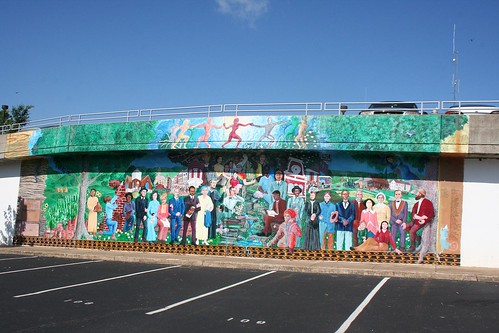
The Lovely Mural
Maybe there is another way to save this important work of art. I have received calls from people with a broad variety of solutions from slicing the concrete into pieces and placing the pieces — Berlin Wall style — around town, to transferring the photographed mural to tiles or canvas to be placed on another wall.
But it’s not just a question about money, it’s a question about values, Simply put: How much is a piece of our culture worth?
My favorite definition of art is that it is the symbolic transformation of experience. We don’t just decorate our homes; we make a symbolic statement about who we are both to ourselves and to those who visit with us. Public art expresses the symbols of the community. It tells us and the world who we are. It shows us where we have been, especially this work.
An artwork on a now underused public wall made by artists and members of the community as a cooperative effort will soon pass from the scene with little public discussion unless we bring it up and talk about it. There is already a small group wondering what to do and many good suggestions are being offered. If you haven’t seen the mural, go take a look. It’s on the east wall of the condemned county courthouse parking facility facing what used to be our city library on east Dickson St.
It is a tableau of many of the characters in our history painted in the context of the place they lived: Fayetteville and Washington County, Arkansas. This is a public work of art that expresses our concern for our heritage and for the people who came before us and influenced our lives. It was made by us and it is our collective concern.
For a community our size there is not much in the way of public visual art. Our architecture and the way we design our streets and parks are the most we tell about ourselves in the way of public aesthetic symbolism. The public live music scene, however, is growing and the galleries of visual arts are too. New venues and more music, theater, dance and performance spaces are cropping up at a delightful pace. Meanwhile, the Lovely Mural will bite the dust and Joe Alexander’s splendid agricultural mural at Maple and Mission will fade off into the sunset. Let’s find the money and the will to somehow move or at least remember our valuable cultural symbols.
Hank Kaminsky, sculptor
Mike Davis, sculptor