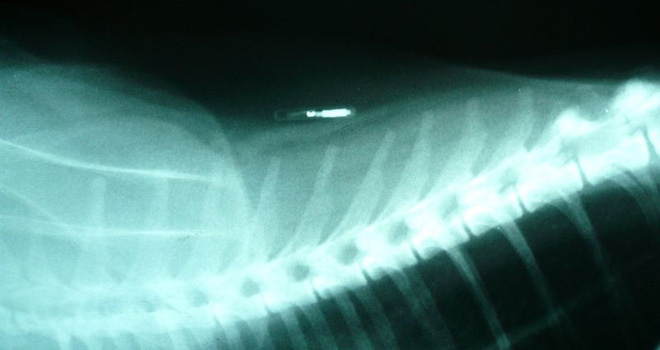
Fayetteville pet owners will no longer have to pay a yearly $5 pet license fee. They will, however, be required to have their pets microchipped.
Council members voted Tuesday night to replace the current annual pet licensing fee with a requirement that all dogs and cats over the age of four months must have an electronic microchip implant.
Microchips, which are about the size of a large grain of rice, are placed under the skin of an animal and can be scanned to reveal details such as contact information of the animal’s owner and vaccination records.
Microchipping costs $20 at the Fayetteville Animal Shelter or can be performed elsewhere by a private veterinarian.
Animal Services Superintendent Justine Middleton said the idea of microchipping was brought about to save money both directly and indirectly.
“For one, we would no longer have to administer the license program which is a bit cumbersome,” said Middleton. “Also, any pet with up-to-date microchip information should be able to be returned home if not immediately, extremely shortly thereafter, therefore saving us the cost of having to kennel those animals and care for them for a 2-or 3-day average stay.”
Several people spoke in opposition to the new requirement saying that government should not mandate technologies like microchipping.
“I feel like my right as a pet owner to choose to have this done is being trampled on,” said Debbie Beckerdite, chairwoman of the local group Northwest Arkansas Citizens for Better Government.
“If you just leave it as is and maybe educate the public that this is available, a conscientious pet owner would choose to have the microchipping done.”
Ward 3 Alderman Bobby Ferrell said he is empathetic to the people opposed to the new law. “I don’t like government mandates at all and I often oppose them,” said Ferrell.
However, in this case, he said he believed vaccination information carried on microchips would come in handy if a resident was bitten by a stray animal.
In researching microchips, Ward 4 Alderwoman Sarah Lewis said she found them to be highly regarded as a strategy for minimizing euthanasia in shelters and returning animals home.
“It’s something worth trying,” said Lewis.
The ordinance was unanimously approved and will go into effect the first week of January.
City staff documents



There’s a $5 licensing fee now? I’ve never heard of that… have people out there been paying it?
Not many people pay it and it’s not really enforced outside of city shelter adoptions. Here’s a link to that info taken from the city’s website.
RE “‘I feel like my right as a pet owner to choose to have this done is being trampled on,’ said Debbie Beckerdite, chairwoman of the local group Northwest Arkansas Citizens for Better Government.”
Oh, waaaaah. Why is a person who chairs a group for better government whining about an example of better government?
I read the U.S. and Arkansas constitutions. There is no right to choose to have this done.
I wonder if Debbie Beckerdite always paid the annual license fees for past years, or if her right as a pet owner to choose to pay the $5 was being trampled on? The city should have records on this. Would a freedom of information request produce a list of pet owners who paid the tax? I know my name won’t be found there, but certainly the chair of the NWA Citizens for Better Government would not be a tax dodger like me.
Laziness. This is going to be even less enforceable than the annual fees. Keep the fee, and enforce it by requiring veterinarians to verify compliance. Once again the city walks past a dollar to pick up a dime.
First step in putting the chip in humans because it is in the best intrest of the goverment. You give them a foot they take a mile.
Can’t shake the idea of a theme for a new Stephen King novel. Maybe “Cujobot.”
I dont like it at all. Way too invasive.
If the microchip can safely and dependably provide information as to the ownership of a pet that has slipped out of its collar, then it is less invasive than euthanasia of an unidentified pet. If it can do away with the need for a firmly-buckled collar at all except for walkies, then it is less invasive than injury or choking fatality caused by a loose pet getting its collar caught on something.
Please don’t suggest that microchipping is a substitute for collaring your dog. Even wearing a microchip, your dog might be a nuisance or a menace to people or other animals. Also, microchipping is useless for I.D. unless you’ve got the matching reader. So an ordinary citizen won’t be able to look at your dog and know that it’s got an owner and chip. If you travel, your dog’s chip might not be readable in a new location or even outside Fayetteville. For these reasons, plus the fact that people will be required to pay what manufacturers and suppliers demand rather than actual cost, it’s not a heaven-sent solution.
I didn’t intend to suggest that the chip entirely replace the collar; I think pets should wear at the least a collar that can slip off to prevent injury or strangulation, as a flea collar can. Perhaps my references to “a pet that has slipped out of its collar” and “firmly-buckled collar” weren’t clear.
An ordinary citizen also can’t get information from a collarless dog without a chip. Unfortunately, neither can the pound.
As far as I can tell, nobody has suggested that microchips are a “heaven-sent” solution. But it’s pretty clear that euthanizing unidentifiable pets isn’t heavenly, either.
Almost all vets, shelters, etc, have universal readers for the microchips. It’s 2011. People should know by now that if an animal is found, one of the first things one does is check for a microchip at nearest vet or shelter.
Animals should always wear a collar with updated information and owners must always register their chip and keep it updated. It’s pretty simple.
This is similar to mandating that rabies shots be given by a vet for the price of $10.00 when the individual could purchase and give the shot for $1.00. A wide variety of chips are available; some are safer for our pets than others, some require periodic registration fees, transfer fees, and fees to update owner contact information which changes frequently, in addition to the initial expense. Mandating a chip does nothing for responsible pet owners. This is another loss of individual freedom and will lead to turning the money wheel with fines for failure to comply, no reduction in staff as the program will likely require more time than the current licensure process to administer. The issue could be addressed in a more positive way with public education and awareness programs resulting in higher compliance with the goal.
The Sarah Lewis “it’s something worth trying” method of legislation seems to come with good intentions, yet dodges any notions of personal rights impact or the role of government. Want to park multiple vehicles in your driveway and a boat behind the fence in your side yard? Better get a permit. Need to park on the street by your house downtown? Here’s your form…
There are GPS dog collars out there that an individual can track from a smartphone app. A microchip only helps at the point when the dog is lost, lasso’d, hungry, and scared. Lawfully requiring one method of pet tracking, even when intentions are good, exceeds the role of government and adds administrative/oversight/enforcement burden that someone lower on the totem pole will have to deal with.
And guess what? Almost all vicious or abandoned animals – stray, cast aside, poorly socialized, or abused – will come from the lousy lot of owners who won’t be bothered to chip them, anyway.
This city council’s ability to exercise legislative and spending restraint is only limited by the number of times it meets.
I am all for the micro chip. Collars come off too easy. I also see no reason for the city to enforce the micro chip rule. Should be up to the pet owner to make that decision.
cats & dogs today guns and freedom tomorrow!
I think it’s a bit unnecessary. I never even knew about the $5 yearly licensing fee. Whoops. I know one of my cats came from the shelter already microchipped, but I have no idea about the other. It seems like if this is something that’s going to be mandated, it should be made more affordable. I get that pets are expensive, but 20 dollars is pretty pricey around the holidays. My cats NEVER go outside.
It’s against city law, but cats roam free all over this town, killing birds and breeding. The city does nothing about it, ignoring their own codes. How do they intend to enforce this extra requirement, go door to door asking if there’s a pet at home?
Are you serious? I bet you hate puppies too.
cat trap fever!
Can we start chipping city employees?
Forced microchipping is a steaming load; I will not chip my pets. NOT.
I don’t think the government should have the right to force implants of any kind whether for people or animals. This really upsets me.
i don’t think this should be a choice mandated by city governments! i’m a dog owner and my dog is chipped – peace of mind should she ever go astray on us that she will be safely returned to us…that is clearly failing that for some reason her collar with contact info is not on her either! i’m all for it! each to their own…
I’m a crazy dog person and even I think that the city is overstepping its boundaries here. I’m not worried about somebody “tracking” my dogs; a microchip isn’t a transmitter, it’s an RFID. I just don’t think that forcing a microchip is a replacement for responsible dog ownership. I also question the enforceability of this measure. Are cops going to be walking around with RFID scanners? Is the city going to force vets to scan for chips and report people who don’t comply?
I have two dogs, both fully vaccinated and never out of my sight, and I had no idea about the city licensing fee. Not only that, but in times when Ranger’s Pantry is bare and the Humane Society is overwhelmed with requests for pet food, asking people to bring in their dogs to FAS and paying $20 to have them chipped is ridiculous and it’s just not going to happen.
For me, $20 is a bargain, but for many people this is a lot of money to allocate, especially for multiple pets.
Once again, the city approves a measure that costs its citizens money, benefits few people, and is almost completely unenforceable. Good job!
I adopted my jack russell from the shelter last spring and he’s a runner. I was very opposed to the idea of microchipping and had never had it done on any of my pets before adopting Sparky, but I’m very grateful for it as the owner of a repeat offender. One of those things you never truly appreciate until that one time they get under the fence (or out the door).
I actually got a ticket from the city for not registering and not spaying my previous dog, and there was a small fine I had to pay with the city. When he got out I had to pick him up from the shelter, pay his registration fee and provide documentation on why he wasn’t fixed. I can only assume that’s what they’ll do in any cases of pets they pick up that aren’t microchipped now.
There is evidence showing that this is not necessarily a safe practice across the board. Some animals do have a problem with it such as developing an immune response to a foreign body. The body tries to encapsulate the foreign object and constantly is working to surround the chip and force it to the surface. Sometimes creating a tumor around the chip. Doesn’t happen often, but I certainly wouldn’t want to do this to a very young or elderly animal. I want to have the right to choose to place an implant in my animal or not. I won’t be participating in this painful program, mandatory or otherwise.
“The British Small Animal Veterinary Association (BSAVA) maintains a database of adverse reactions to microchips. Since the database was started in 1996, over 4 million animals have been microchipped and only 391 adverse reactions have been reported. Of these reactions, migration of the microchip from its original implantation site is the most common problem reported. Other problems, such as failure of the microchip, hair loss, infection, swelling, and tumor formation, were reported in much lower numbers.”
http://www.avma.org/issues/microchipping/microchipping_faq.asp
RE “I won’t be participating in this painful program, mandatory or otherwise.”
No, you’ll participate in the unidentified pet euthanasia program, which has painful and fatal effects in 100% of cases. I guess you’ll show them.
Euthanasia should not be painful. I’m not sure what you are thinking here.
Do you know by what rate or by what numbers euthanasias have decreased in communities that require microchipping? Taking into consideration new laws that require pets to be indoors or on leashes, decrease or increase in pets in the community, effectiveness of lost/found programs, etc. In other words, what are claims being based on?
In rare cases microchipping can cause problems such as fibrosarcoma, which can be painful and fatal, so maybe other measures for I.D. should be available alongside chipping. The shelter might at least continue its traditional lost/found program and not assume community-wide conversion to chipping.
RE “…maybe other measures for I.D. should be available alongside chipping.”
I recommend tattooing a UPC symbol on their bellies, and a national pet database..
Euthanasia is oftentimes painful. Shelters still use the gassing and heart stick methods. Even when they are given a shot to “die peacefully”, they aren’t always given sedation. Not to mention, dogs KNOW by the smell that they are being taken into the room of death. So many shelters gas, still. This is a slow and painful death for animals. I won’t even begin to talk about the heart stick method. Anyway you look at it, euthanizing is killing and it’s not nice.
I wish people could spend a day working with at an animal shelter/clinic and see how important microchipping is for recovering a lost pet.
I agree, I volunteered at the Fayetteville Animal Shelter for a year and a half and as a result, I believe microchipping pets is a good practice. I question whether it needs to be mandated by the city government, particularly when it will be difficult to enforce, but I don’t question the safety and usefulness of microchipping.
@ David Franks- Every dog I’ve ever owned has been well trained, spayed/neutered, and kept safe from harm and lived into old age without the use of a microchip. Part of my job as a caring pet owner is to balance the benefits and risks to my pet’s well-being of any invasive treatment, procedure, or (in this case) implant. I, and quite a few veterinarians, are not convinced that all the evidence is in regarding the safety and efficacy of this device. I maintain that I don’t think the program should be mandatory. Also, I find your abrasive comment not conducive to fostering an intelligent sharing of information between people. I’m not judging your character because I don’t know you, but it seemed like a bullying tactic to shut down another person’s participation that differed from your own.
I find your outsized huffiness and adopted martyrdom not conducive to fostering an intelligent sharing of information between people. I’m not judging your character because I don’t know you, but it seemed like a bullying tactic to shut down another person’s participation that differed from your own.
But seriously. Congratulations on your caring and successful pet ownership. I tend to agree with you that chipping shouldn’t be mandatory, in that there should be no cause to even consider making it mandatory. Perhaps they should subject neglectful pet owners and pet abusers to public shaming and put them to work at the Humane Society or Animal Control for a while. Pets can’t help being animals. People can, but not consistently.
Everyone that said his shouldn’t be mandatory is right. I shouldn’t be. Unfortunately over 2000 pets are euthanized just at the Fayetteville shelter every year. “pets” being the key word. My house was broken into once and the jerks that did it let my dogs out in the process. Up to that point my dogs also never got out. I thought they stole my dogs and I would never see them again and then I got the call from the shelter. Because of the microchip I got my dogs back. Never say never. Stop whining people and be responsible. Microchip and spay/neuter your pets.
Sylntgreen — Suppose your dogs had not been microchipped. The shelter would have picked them up just as they did in reality, you wouldn’t have relied on the chip but would have already reported them to the shelter as missing, with a description. The shelter would have compared your report to the actual dogs they had in custody and they would have returned the dogs to you as they did. Instead, what happened seems to be that instead of using verbal or photo descriptions and comparisons they used a machine to read an implanted chip. The results would have been the same. This presupposes a staff who check descriptions against actual animals as opposed to operating a microchip checking machine..
Mr Chips, obviously you have not worked in a shelter or done any animal rescue work. Chips are awesome. I don’t know how effective trying to mandate them are in a non dog friendly area such as Fayetteville. However, if you are saying that chips are no better than the “call the shelter give description method”, you are way off.
So glad I don’t have a dog in this hunt.
Mr. Chips I actually never had a chance to call because they were calling me even before I got off the phone with the police. I think this ordinance will only be enforced on someone who’s dog is caught loose. I seriously doubt an underfunded city department would have time to go door to door enforcing this ordinance.
What better way to increase funding than by issuing citations!
What euthanasia method does our shelter use?
Louie, I was told Fayetteville’s shelter euthanizing by injection. Whether or not Fayetteville’s shelter sedates prior, is unknown. I don’t know if this is a fact, just what I was told by a volunteer at the shelter. So many shelters still use the gassing method and heart stick method. It is so inhumane. Just because a dog “lives” in Washington County doesn’t mean it can’t end up somewhere, anywhere, in another city, where this inhumane method occurs. It is a disgusting situation. If anything, spaying and neutering should be mandated.