Wednesday, Jun. 19, 2013

Clear Skies 68°F
  • About
  • Advertise
  • Sponsors
    • View Sponsors
    • Weekly sponsor deals
  • Contact

Fayetteville Flyer

  • Home
  • News & Views
    • Flyer News
  • Arts, Events & Life
  • Sports
    • Schedules
      • Arkansas Baseball
      • Arkansas Basketball
      • Arkansas Football
  • Columns & Features
    • Beer Reviews
    • Book Reviews
    • Giveaways
    • Recipes
    • Trail Reviews
    • Weekly Deals
  • Sections
    • News & Views
    • Arts, Events & Life
    • Columns & Features
    • Sports
  • Calendar
  • Daily Flyer
  • Weekly Deals
  • Public Meetings
  • Movie Listings
    • Fiesta Square
    • Razorback Cinema
  • Garage Sales
    • Most Popular

      This week

    • Plans unveiled for ‘Amazeum’ children’s museum in Bentonville

      22 Comments

    • Fayetteville considers door-to-door sales permits and other regulations

      14 Comments

    • Comments

      Most Recent

    • josh on:

      Fayetteville considers door-to-door sales permits and other regulations

    • Hub on:

      Fayetteville considers door-to-door sales permits and other regulations

50 Comments

News & Views

Council approves Project Cleveland

  • by Todd Gill, Flyer Staff
    on June 20, 2012 at 1:35 am

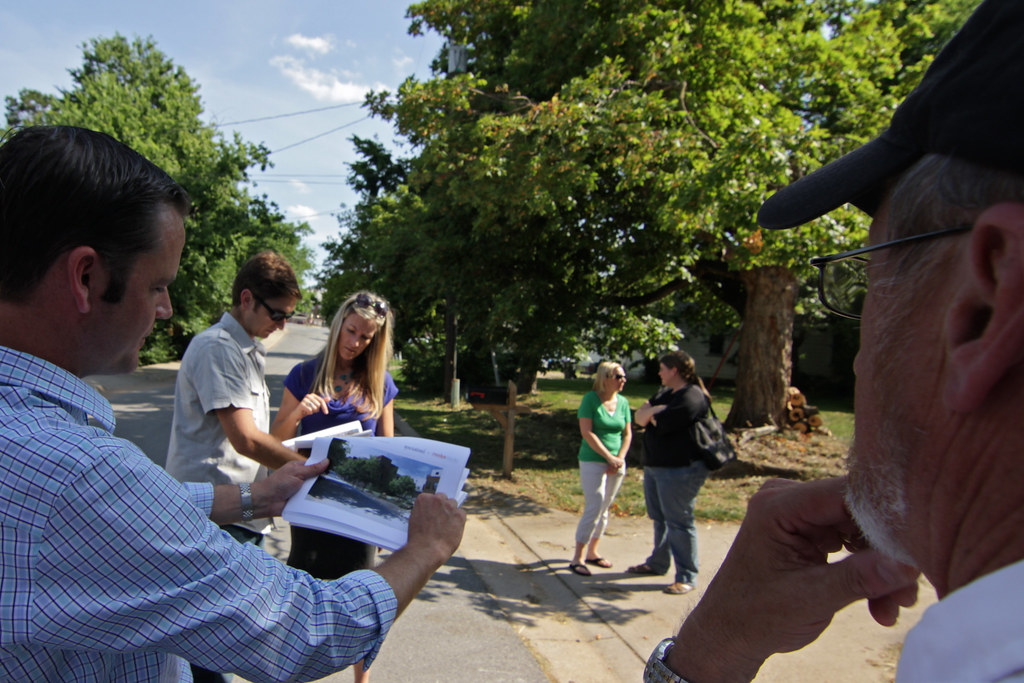
Mayor Lioneld Jordan (right) listens as developer Seth Mims outlines plans for Project Cleveland while Modus Studio architect Chris Baribeau talks with Ward 4 Alderwoman Sarah Lewis. The team led council members, neighbors and reporters on a walking tour of the proposed location last week.

Photo: Todd Gill, Flyer staff

The Fayetteville City Council approved plans for Project Cleveland, a 122-unit student apartment complex across from the University of Arkansas campus, during Tuesday night’s regular meeting.

The 6-2 decision came shortly after midnight and followed nearly five hours of debate. Alderman Mark Kinion and council member Rhonda Adams voted against the project, which established a planned zoning district at West Cleveland Street and North Hall Avenue. Kinion sided with area neighbors and said while he liked the design of the complex, he felt it was presented at the wrong time and at the wrong location. Adams said she didn’t hear enough evidence to prove the need for a rezoning of the property.

The 2.71-acre site is currently home to a 60-unit apartment complex across the street from a five-story UA dormitory. Developers Seth Mims and Jeremy Hudson with Specialized Real Estate Group plan to replace the existing complex and several single-family rental houses along Hall Avenue with a LEED Silver-certified apartment building designed by Fayetteville architecture firm Modus Studio, the same team behind the popular Eco Modern Flats complex.

The developers agreed to pursue some final changes to their plans at the request of the council Tuesday night including construction of a right-only turn out of the building’s parking garage onto Hall Avenue and the addition of several apartment design elements along Cleveland Street.

The changes were two of many adjustments made over the past few months to accommodate city staff and neighbors who said the building was too large in the original proposal. The five-story complex was reduced to two stories where it meets the neighborhood to the north, and 100 units were removed from the design to decrease the density of the project.

While the first hearing of the project included many complaints from nearby residents who were opposed to Project Cleveland, Tuesday’s discussion was dominated by residents and university students who were in favor of the complex. Most cited the building’s close proximity to campus as their top reason for supporting the project, particularly because it would create an opportunity to walk to class instead of having to drive and pay to park.

Others cited the plan’s careful attention to City Plan 2030 which serves as the city’s comprehensive land use plan and aims to establishes a vision for what Fayetteville can achieve.

Council members in support said while they sympathized with neighbors who opposed changes to their established neighborhood, a student housing development that promotes infill and walkability, and that is located directly next to the university, is exactly the type of project Fayetteville needs to encourage at a time when enrollment is up and on-campus housing availability is down.

For more details and information on Project Cleveland, see our June 18 story.

Tags: Project Cleveland

    Related posts

  • cleveland4 Neighbors drop Project Cleveland lawsuit, UA to acquire property
  • clevelandft Council to continue Project Cleveland discussion
  • cleveland More student apartment plans surface


50 Comments

Fayetteville Flyer doesn't necessarily condone the comments here, nor does it review every post. Read our full policy.

  1. gm says:
    Wednesday, Jun 20, 2012 at 1:50 am

    Comment removed. See our policy.

  2. CLee says:
    Wednesday, Jun 20, 2012 at 5:27 am

    Unbelievable! Sarah Lewis once again listens with her mouth while ignoring her constituents.

    Let’s see, a few college students want this so they can park free. What a great reason to put this monstrosity in the middle of a residential neighborhood, right by a elementary school and on a street that just 18 months ago people were talking about already being one of the most dangerous in town.

    All hail the god of INFILL! The neighbors be darned; we must worship at the feet of the almighty INFILL! Let’s not stop until Fayetteville is one gigantic apartment complex.

  3. Zapp Brannigan says:
    Wednesday, Jun 20, 2012 at 7:14 am

    Thank you for standing up for the neighborhoods Mr Kinion! I don’t wanna hear any bellyaching about student enrollment growing at historically unprecedented rates, this is definitely the “wrong time” to build student housing. And what’s with building it within walking distance from campus? Couldn’t they have found a better location?

  4. Innarested Observer says:
    Wednesday, Jun 20, 2012 at 8:13 am

    Folks, you have two choices: Up, or Out. If you don’t want the UA building out, then they’re going to have to build up. Would you be OK with a few 12- or 20-story highrises surrounded by parking garages at, say, where Lot 56 now resides?

    Personally, that wouldn’t bother me a bit. Growth means growing pains, which are… painful. Suck it up. The days when Fayetteville was a sleepy little college burg are OVER.

  5. Dennis says:
    Wednesday, Jun 20, 2012 at 9:44 am

    Good decision.

  6. Alasondro Alegre The Chief says:
    Wednesday, Jun 20, 2012 at 9:56 am

    Cue the griping from Helen and the rest of the University Heights cronies. I bet their private neighborhood list proc is full of good reading today!

  7. Mr. Dooley says:
    Wednesday, Jun 20, 2012 at 10:05 am

    Kudos to the Fayetteville Flyer for covering this story and posting it today. The Northwest Arkansas Times had nothing about it in print or on its website this morning.

  8. DG says:
    Wednesday, Jun 20, 2012 at 10:18 am

    This is replacing an existing apartment complex, correct? It would seem the impact is minimal. And I’m sure it will look better than what it replaces.

    • Michael says:
      Wednesday, Jun 20, 2012 at 11:51 am

      Existing complex and some quite honestly run down looking houses.

  9. Beverly Schaffer says:
    Wednesday, Jun 20, 2012 at 11:56 am

    I would like to praiseTodd Gill and the Fayetteville Flyer for the excellent reporting from last night’s city council meeting. My husband and I were very disappointed with the decision but I am impressed with the fair, thorough and balanced tone of your story. It captures the essence of the saga without judging or labeling the parties or editorializing the outcome. Good job!

  10. Informed voter says:
    Wednesday, Jun 20, 2012 at 12:40 pm

    Maybe some of you who love this type of development should move to a big city like Detroit so you can live your urban life. I like Fayetteville as a small university town.
    When you hear these folks in the neighborhood complaining about this type of structure you tend to forget they bought their houses with the expectation of limited high density housing. You would not like it if it were in your backyard.

    • Michael says:
      Wednesday, Jun 20, 2012 at 12:47 pm

      Only a fool buys a house next to a major university and doesn’t expect high density housing to be nearby.

    • glutenfree says:
      Wednesday, Jun 20, 2012 at 12:47 pm

      I don’t know that I would hate this if it were in my backyard.

      I get feeling pushed around by all the infill happening in Fayetteville. Its happened to me and my family, too.

      What I don’t understand is choosing to live across the street from a major university campus with high rise dorms housing hundreds of students literally within a few hundred feet of your homes and being so upset that another building is going up that will basically be the same format.

      Its not like this is Wilson Park and they are bulldozing bungalows. (Wilson Park area is getting its own 5-story apartments adjacent to their neighborhood, however).

      This is directly cross from 9-story high-rise dorms that have been in existence for nearly 50 years. It is replacing run-down, low rent apartments. I just don’t see it as the major imposition that many of the residents seem to think it is.

      I wish Fayetteville would put a moratorium on garden-style apartments, and encourage these kinds of developments instead. This building may actually have a usable life-span of more than 20 years before turning into a Section-8 hellhole.

      • glutenfree says:
        Wednesday, Jun 20, 2012 at 1:15 pm

        That being said, hopefully this development group and others will look north of campus. There are some very dilapidated and mismanaged apartment properties in the North/Leverett area that are begging to be knocked down and rebuilt.

        That is one of the most walkable areas of the city, close to campus and adjacent to the trail system.

    • young voter says:
      Wednesday, Jun 20, 2012 at 1:08 pm

      If I bought my house 2 blocks from a growing university, I would not have expectations of limited high density housing across the street from a group of university dorms and brand new retail shops. It’s the expectations that are a little cloudy to me. Especially since they are replacing a run down high density housing complex.

  11. Helen says:
    Wednesday, Jun 20, 2012 at 12:49 pm

    people who do not live in the neighborhood are enthusiastic about the project and people who did not live in the neighborhood decide about the project. In Money We Trust; and and People We Ignore.

  12. Sarah Marsh says:
    Wednesday, Jun 20, 2012 at 3:34 pm

    I attended the meeting last night and I think the Council did a good job listening to and addressing the neighbor’s concerns.

    They were concerned about traffic.
    This development will reduce overall traffic by putting the place that people live next to the place where they will work and go to school, thus enabling them to walk or ride their bikes instead of commute in from across town. The developer is installing traffic calming measures such as narrower streets, a separate bike lane, on-street parking, and raised crosswalks to further manage traffic.

    They were concerned about pedestrian safety.
    This development will improve pedestrian safety by installing nice new sidewalks, hopefully 8′ wide if the neighbors will cooperate. These nice new sidewalks will have fewer curb cuts, raised and illuminated cross walks, and be buffered from the street by rows of shade trees and parallel on-street parking.

    They were worried about noise and rowdy college students.
    This development improves the existing condition by adding on-site 24 hr management, eliminating parking lot noise by wrapping the parking garage with the building, and adds landscaped buffers.

    They were concerned about storm water run-off and impact to utilities such as water and sewer.
    This development improves the existing condition by replacing and enlarging the utility lines in the neighborhood and will capture storm water run-off from it’s own site as well as over six additional acres from adjacent properties. The incorporation of low-impact development strategies will help filter storm-water and promote infiltration which will reduce the load on our municipal water treatment facility.

    They were concerned about the impact on the neighboring elementary school.
    This development will contribute over $187,000 a year in tax revenue to our school system. As a non-smoking development it will eliminate the problem of University students and workers loitering and smoking in view of the students. It will replace the dumpy rental properties with the empty kegs and beer cans on the lawn with beautiful pocket parks and a coffee shop where parents can visit their neighbors over a cappuccino while waiting for Junior’s school day to end before safely walking home using the safe new sidewalks.

    They voiced concerns about the need for a long term plan.
    There is a long term plan. It is called City Plan 2030 and it was developed and adopted by the citizens of Fayetteville. It is posted on the wall of the Council Chambers. This development is 100% consistent with the goals and intent of the plan.

    The City Council did a very good job listening to the concerns of the neighborhood. With the approval of this project they are creating real solutions and doing so on the dime of a private investor in a manner which will create badly needed jobs in the design and construction sectors building energy-efficient, attainable housing for students and University employees directly adjacent to campus while increasing the tax revenue flowing to our schools. Great job City Council!

    -Sarah Marsh
    Candidate for Fayetteville City Council, Ward 1, Position 2
    Facilitator, Fayetteville Forward Green Economy Group

    • Informed voter says:
      Thursday, Jun 21, 2012 at 1:01 am

      Ms Marsh, you will be the perfect replacement for the ward 1 pos 2 council member. You pontificate adnaseum with misconstrued facts. Less than 400 people participated in the 2030 plan and it was only approved by the city council, not the public. The city council is not supposed to consider money (tax base) in their decisions.
      On street parking with narrow streets will congest the traffic.
      Do you really think these apartment residents won’t use cars?
      Attainable housing? At these rates. In this economy.
      Get real.
      Is anyone else running for this council position?

      • Huh? says:
        Thursday, Jun 21, 2012 at 10:33 pm

        City council shouldn’t consider the tax base? Afraid I don’t get that one. As far as I’m concerned, any alderman that ignores the effect of their decision on the tax base would not be making a responsible decision.

        • Informed voter says:
          Friday, Jun 22, 2012 at 12:41 am

          That’s what Kit Williams keeps telling the council. Go figure.

      • Jerry Dude says:
        Thursday, Jun 21, 2012 at 11:06 pm

        The public voted when they chose not to attend the 2030 workshops.

        I didn’t become a downtown resident because I wanted to give up my car. I moved downtown so I could reduce the amount of driving I do. Most weeks I only use the car on the weekends. As the downtown population density and amenities increase people will become more comfortable with walking and biking. Downsizing, and moving into town has improved my quality of life much more than I had imagined. I recommend everyone move to within a few miles of their place of employment, and demand better sidewalks in your neighborhood.

      • David Franks says:
        Thursday, Jun 21, 2012 at 11:21 pm

        RE “You pontificate adnaseum with misconstrued facts.”
        Ms. Kettle, meet Mr. Pot.

        RE “Less than 400 people participated in the 2030 plan”
        But it was the people who really cared. I mean, really: I’ve been to visioneering meetings and design charrettes. Who else would want to sit at tables and brainstorm about things with other people who are concerned about stuff?

        RE “and it was only approved by the city council, not the public.”
        Any other time, you’d be complaining about how the council has no direction.

        RE “The city council is not supposed to consider money (tax base) in their decisions.”
        How do you spell that noise that people make when they’ve read something they find incredible? I think it begins with a “p”.

        RE “On street parking with narrow streets will congest the traffic.”
        If causing traffic to respect the neighborhood speed limit constitutes congestion, that would be true. The streets are going to be only one lane in each direction regardless of other details of their design.

        RE “Do you really think these apartment residents won’t use cars?”
        Did somebody say that? They are likely to use them less for their day-to-day routines.

        RE “Attainable housing? At these rates. In this economy.”
        That’s one reason they are doubling the number of units on the site: greater economy of development. The market will take care of any overcharging on rent.

        RE “Get real.”
        You first.

        RE “Is anyone else running for this council position?”
        Are you waiting for a nomination?

    • John Ruskin says:
      Thursday, Jun 21, 2012 at 6:58 am

      A pity to have lost a green spokesperson to standardized greenwash. The fact remains that the university is promoting its own growth without regard to its ability to house its own clientele and without taking measures to limit traffic responsibly. There are more than the 2 cited alternatives “up” and “out” for solving the UA’s problems. The UA is a money machine for the Chamber and other special interests but it’s hell on the environment and the quieter element among the population.

      • Sarah Marsh says:
        Thursday, Jun 21, 2012 at 11:26 am

        I absolutely agree with you that the University is seeing unprecedented growth and doesn’t currently have sufficient housing which is resulting in an increase in traffic. Where we disagree is on how to deal with it. We can choose to sit back and point fingers and complain or we can seize the opportunity to share in the prosperity by enabling the free market to offer solutions to this growing demand. I advocate the course of action. Where you see problems, I see opportunities.

        Yes, the UofA is a money machine. Our community is better because of it. The Razorbacks Athletics Program is a significant part of the foundation of our tourism and hospitality industry. We would be fools to demand that the University provide hotels and restaurants for all of the visiting fans while complaining about the caravans of consumers invading our town and clogging up traffic on game days. Would it be any wiser to tell the University that they must provide housing for all of their students and staff? Would people be complaining if some other employer was growing so impressively? Our community and our economy benefit by having this Institution at our heart. Their continued success is our opportunity.

        The University has launched several initiatives to address their environmental impact. Their new facilities are being built to LEED standards, their food service provider has cut food waste in half, they’ve undertaken massive energy efficiency improvements on their district energy systems and lighting standards, and are inventorying their storm water impact as a step towards identifying solutions. The University is a big ship and turning it around won’t happen over night but the process is well underway. Ultimately their whole mission is to create one of the greenest products in the world, well-educated citizens.

        We all live in the same community and instead of lobbing unsupported allegations of greenwashing against me while claiming there are other solutions besides “up” and “out” without offering them, we need to be working together. Join me at the Green Economy Group, the Advocates for Public Transit, or on the Fayetteville Forward Economic Accountability Council and offer your suggestions for solving our environmental, economic, and transportation challenges. I’ll be at the Citizen’s First Congress this weekend lobbying for resolutions supporting energy-efficiency and green job creation, the Main Street Mobility Act to remove barriers to transit and inclusive mobility, and the Equal Rights Amendment to ensure that all of our citizens have equal opportunities in the new green economy, regardless of gender. Your ideas and participation are welcome.

        Sarah Marsh
        Candidate for Fayetteville City Council, Ward 1, Position 2
        Facilitator, Fayetteville Forward Green Economy Group

        • Innarested Observer says:
          Thursday, Jun 21, 2012 at 2:09 pm

          Yeah, I’m afraid “up” or “out” is it. How can it not be? The UA either goes vertical with larger buildings than we normally have here (like is done at many large state universities facing even more drastic space problems), or it expands outwardly by consuming nearby space as it becomes available. This is a practice the UA has done on MANY occasions, which led to the Harmon Street apartments, for example. This is also why the UA made a $50 million offer to the city to purchase the grounds of Fayetteville HS.

          If the UA doesn’t build UP or expand OUT… what, pray tell, is the alternative? I’m confused because I kinda thought we were on the same page with this, and not “lobbing unsupported claims at you.”

          I agree with the city’s decision and the UA’s plans. And I can tell other surrounding neighborhoods: this isn’t stopping. The UA is actively looking for expansion room to grow OUT. If you want to stop it, encourage them to build UP. Because there simply isn’t room otherwise.

        • John Ruskin says:
          Thursday, Jun 21, 2012 at 2:42 pm

          Sarah Marsh – You’re quite right that I should have stated some of the alternatives I alluded to, but I’m forced to admit I have no knowledge of the inner workings of the UA or even of basic rules. I only suffer the effects. (I suggest we may live in different parts of town.) So I have to apologize if the UA already restricts use of cars to upper classmen, requires that freshmen live on campus, has established an optimum size for a university expressed as a percentage of population and limits enrollment accordingly, has negotiated the siting of essentials (private retail?) within walking distance, runs small, clean-fuel, transport around town and campus, has safe bike routes/lanes through all its properties, etc.. Maybe state run schools can’t do these things. Maybe UA already has done them and it hasn’t helped. If the only choices really are to build horizontally or to build vertically, while encouraging increases in population and number of cars, you must admit that sooner or later the only option will be “up”, so we’d best be considering it.

      • David Franks says:
        Thursday, Jun 21, 2012 at 12:27 pm

        RE “The fact remains that the university is promoting its own growth without regard to its ability to house its own clientele”
        A fact, perhaps, but it doesn’t stand alone. No university undertakes to house its full enrollment, and enrollment increases often happen far faster than the pipeline for university construction can handle anyway. Further, academic construction will trump residential construction when a university addresses the needs of its clientele. Even further, students tend to prefer off-campus housing, and it makes more sense to stick the “special interests” with changes in the residential market rather than have the public pay for housing to accommodate peak enrollment. Modern dormitories are very expensive.

        RE “and without taking measures to limit traffic responsibly”
        The University does a pretty good job overall of coexisting with the city, and the students. However, traffic outside the confines of campus is not really their concern– nor should it be, as it is not within their control. But do you really want the relatively-unaccountable University to run this town? You’re better off with your elected dictators.

        RE “There are more than the 2 cited alternatives “up” and “out” for solving the UA’s problems.”
        And those are… ?

        RE “The UA is a money machine for the Chamber and other special interests”
        It also gins quite a bit of money for everybody else who benefits from the presence and spending of students, faculty, staff, and visitors. Those people aren’t dropping their dollars at the front desk of the Chamber. By the way: your posts indicate that you also are a “special interest”.

        Perhaps you should calm down. Your arguments appeal to emotion rather than fact.

    • timeismoney says:
      Thursday, Jun 21, 2012 at 9:18 am

      Ms. Marsh. Thank you for your thoughtful reply. It is an emotional subject for some, but projects like this will help grow our city without ugly sprawl. Replacing an eyesore with a well thought project is a no brainer. After this project has been completed it will be difficult to find any one admitting to opposing it.

    • James (Butch) Coger says:
      Friday, Jun 22, 2012 at 7:06 pm

      Ms. Marsh is right on with her knowledge and comments on project Cleveland. The not in my back yard people were well organized and worked very hard to collect their 216 signatures kudos. I think the one thing that worked against them the most was you buy a house across the street from a 9 stories UofA building with a Frat house on the same side of the street you live on just a few door down from you and you have the expectation that an existing decaying apartment complex will not be replaced with an modern larger complex? I would think who ever I pray too if I pray that it is Specialty Real estate Group and not the UofA.

  13. CLee says:
    Wednesday, Jun 20, 2012 at 6:34 pm

    I think my head will explode if I hear one more politician or would-be politician shrug their shoulders and say: It’s in the City Plan 2030, so therefor we are duty bound to worship at the altar of INFILL and place a high-rise apartment complex anywhere we want, neighbors be damned.”

    I didn’t vote for this so-called plan, and I’m not aware of any laws that say the city has to be a slave to it.

    • Informed voter says:
      Friday, Jun 22, 2012 at 12:43 am

      Amen.

  14. Razorback Fan and Funky Fayetteville Lover says:
    Wednesday, Jun 20, 2012 at 7:27 pm

    I am deeply disappointed at this decision. While I love the university and its culture, this housing complex is too large and not appropriate for the neighborhood and the elementary school across the street. Alternative housing in the form of cottages or scaled down apartment complex of 2 stories would be something that the neighborhood would have supported. But the Council rolled once against to developers and monied interests. This is killing the quality of life for the long term Fayetteville residents. How much more unwise and inappropriate development can Fayetteville absorb before it is no longer the cool, fun place we know it to be?

  15. Informed voter says:
    Friday, Jun 22, 2012 at 12:38 am

    DF let’s answer your reply that should be answered by Ms Marsh.

    RE “You pontificate adnaseum with misconstrued facts.”
    Ms. Kettle, meet Mr. Pot.

    Double check your reply.

    RE “Less than 400 people participated in the 2030 plan”
    But it was the people who really cared. I mean, really: I’ve been to visioneering meetings and design charrettes. Who else would want to sit at tables and brainstorm about things with other people who are concerned about stuff?

    Marsh said the CITIZENS formulated and adopted 2030. .

    RE “and it was only approved by the city council, not the public.”
    Any other time, you’d be complaining about how the council has no direction.

    This was not voted on by the Citizens.

    RE “The city council is not supposed to consider money (tax base) in their decisions.”
    How do you spell that noise that people make when they’ve read something they find incredible? I think it begins with a “p”.

    Kit Williams is constantly reminding the council they may not use tax base in their decisions.

    RE “On street parking with narrow streets will congest the traffic.”
    If causing traffic to respect the neighborhood speed limit constitutes congestion, that would be true. The streets are going to be only one lane in each direction regardless of other details of their design.

    Have fun getting emergency vehicles through that.

    RE “Attainable housing? At these rates. In this economy.”
    That’s one reason they are doubling the number of units on the site: greater economy of development. The market will take care of any overcharging on rent.

    The developers are doubling the number of units so they can make more money. Your idea of the market taking care of the rent charges is pretty lame. They whine until mommy and daddy pony up the bucks so they can be big Texas fish in our little hog pond.

    RE “Get real.”
    You first.

    I wasn’t addressing the comment to you.

    RE “Is anyone else running for this council position?”
    Are you waiting for a nomination?

    Not a chance. And since you don’t even live here you aren’t either.

    • David Franks says:
      Friday, Jun 22, 2012 at 2:23 am

      RE “Double check your reply.”
      Well, aren’t we a fine set of cookware. But then I wasn’t pontificating about pontification.

      RE “Marsh said the CITIZENS formulated and adopted 2030.”
      Are you saying those people weren’t citizens?

      RE “This was not voted on by the Citizens.”
      I didn’t say it was. I pointed out that it gives the council direction in some decisions. Every city of any size needs a master plan. Some cities have master plans developed with no citizen input at all.

      RE “Kit Williams is constantly reminding the council they may not use tax base in their decisions.”
      You are quite correct– I had forgotten that. And thank goodness– I still don’t know how to spell that word.

      RE “Have fun getting emergency vehicles through that.”
      That’s a different issue from traffic congestion. But since the streets will still be designed for emergency vehicle access, it shouldn’t make any difference. Cars will get out of the way (or not) just like always.

      RE “The developers are doubling the number of units so they can make more money. Your idea of the market taking care of the rent charges is pretty lame. They whine until mommy and daddy pony up the bucks so they can be big Texas fish in our little hog pond.”
      That is part of the economy of building more units. As the land cost is fixed; building more units lowers the cost per unit, which lowers the absolute rent requirement. As for parents ponying up money, that is one possible aspect of the market. The fact that you don’t appear to like the hoity-toity sort of rich kids who might live in these apartments is irrelevant.

      RE “I wasn’t addressing the comment to you.”
      That’s okay. Some of your remarks were no less unreal.

      RE “Not a chance. And since you don’t even live here you aren’t either.”
      While it is the case that I don’t live in any of the city council wards, I do have a Fayetteville address. But, as I’ve said before, I run /from/ office. And my eligibility is irrelevant to my point that you do a lot of complaining about the way things are run by other people.

  16. Dan Coody says:
    Friday, Jun 22, 2012 at 10:34 am

    We do not have time to put together yet another committee to come up with a plan that should be a discussion undertaken by the whole community. This issue calls for leadership that is willing to step out front to facilitate a discussion that is as serious as the topic, itself. I think there are plenty of high-density student housing units either under construction or already permitted to satisfy the needs of student population growth for the short term. I propose a 120 day moratorium on permits until planning guidelines and a well-thought-out overlay district can be developed. We should have a series of well-advertised public meetings held after working hours so people can actually attend to discuss:

    Location and Compatibility

    Mixed Use, Height, and Density

    Parking, Traffic, and Infrastructure needs

    Design Criteria

    And then a wrap-up to make sure the public’s wishes are fairly translated into a clear and concise public policy document.

    This should have taken place 2 years ago after the scholarship lottery passed. The city completely missed an opportunity to develop a new zoning classification during the 2030 plan updates. The guiding principals that are in place are not specific enough to this issue to manage this type of development. High density student housing has been sweeping through university towns in recent years but we weren’t paying attention so, once again, we have been caught without a plan. It is clear that our city has lost the ability to look beyond our border and learn from other cities that have gone through the exact same experience.

    I feel certain that these developments would be much less controversial if they are built with quality materials, in a walkable location, and are located appropriately. Looking at the GIS and zoning maps, it is clear there is a lot of land surrounding the University that is underdeveloped and ripe for improvement. Perhaps we should be looking at areas like that first. Density bonuses could be offered to those projects that exceed our criteria.

    • John Ruskin says:
      Friday, Jun 22, 2012 at 11:10 am

      Interesting ideas. Where is the land you’re thinking of? Could you be more specific?

    • David Franks says:
      Friday, Jun 22, 2012 at 12:42 pm

      RE “We do not have time to put together yet another committee to come up with a plan that should be a discussion undertaken by the whole community.”
      Exactly. Throwing such a discussion out to the community at large wouldn’t take any time at all.

      RE “We should have a series of well-advertised public meetings held after working hours… This should have taken place 2 years ago”
      Or six years ago.

      RE “The guiding principals that are in place are not specific enough to this issue to manage this type of development.”
      If only the previous administration had created a better foundation for the current administration to update..

      RE “And then a wrap-up to make sure the public’s wishes are fairly translated into a clear and concise public policy document.”
      And then people can complain later because so few citizens participated. And that “special interests” somehow shaped a citizen-directed effort.

      RE “it is clear there is a lot of land surrounding the University that is underdeveloped and ripe for improvement.”
      Is any of that land available? Are you sure that these developers didn’t consider other locations?

      I don’t entirely disagree that another bout of community input might be appropriate, and I think some of your proposals are good. But haven’t you already had a chance at this? Is high-density student housing really such a new issue? (It was a problem in Austin in 1985.) Isn’t City Plan 2025 at the root of these “problems”?

      No barrage of public meetings, charrettes, visioneering sessions, or palliative campaign speeches is going to cure the average citizen of his brain-stem-activated backyard-protection reflex.

      • Innarested Observer says:
        Friday, Jun 22, 2012 at 1:07 pm

        Like most politicians, especially those who are campaigning, they have a fluid point of view.

        • Dan Coody says:
          Friday, Jun 22, 2012 at 2:51 pm

          If by “fluid” you mean “flexible within a framework”, I am guilty as charged. I prefer that to “set in stone, regardless of changing realities on the ground”.

          When I write a position on something and post it for everyone to read, if I radically change direction depending on audience, everyone will have the record to ask me about. ALL incumbents and candidates should state clearly and specifically where they stand. Platitudes should not be good enough. And when they change positions for no apparent reason or rewrite history, they should be asked about it. Even the incumbents. Perhaps ESPECIALLY the incumbents. Why should they be let off the hook? I do not mind being challenged by my critics. Often I learn something new.

          I will present some perspectives that challenge convention and others that reinforce tradition. But I will present ideas and welcome debate on them. I have never hidden from the media or the public. It certainly makes me a target. I can see why others stay silent or have others speak for them. It’s easier. It’s safer. I am not that candidate.

          At the end of this week the total tickets issued for all of downtown for 22 months will top 34,000. Selling bonds based on issuing tickets to build something that has no proven need is nuts. Silence is the voice of complicity.

        • C.D says:
          Friday, Jun 22, 2012 at 3:41 pm

          RE: “At the end of this week the total tickets issued for all of downtown for 22 months will top 34,000″
          I have never had one. I think it’s because I pay the $1 per hour fee (max $5), which I consider perfectly reasonable, provided its for a business I think is worth frequenting. For example, I never paid for parking to visit certain restaurants that have now closed down. Mind you, I never went there even when parking was free. However, I am happy to pay the fee to go to TheaterSquared, Bordinos or the Hoghaus. If I’m paying $20-$40 for a meal/show, $2-$3 for parking is nothing. I never have understood why everyone is criticizing it so much.

        • Innarested Observer says:
          Friday, Jun 22, 2012 at 7:01 pm

          Dan, I actually think we’re in agreement regarding parking. I live within walking distance to Dickson and the square, although I sometimes drive. The parking is ample and affordable. I still don’t like it, but that’s my inner cheapskate talking. What grinds my gears is the idea that we need a parking deck, or that we need to give the WAC $289,000 a year. Really?

          I’m on Dickson daily. Many times… heck, most even… there is plenty of available parking.

          I am curious about your stance on the biker fest.

        • Innarested Observer says:
          Sunday, Jun 24, 2012 at 11:19 pm

          I’ll hang up and wait…

    • James (Butch) Coger says:
      Friday, Jun 22, 2012 at 6:50 pm

      Thanks Dan for stepping up to the plate. Your Mayoral experience shines once again and that is what we need now. Our current city government in my opinion has been asleep at the wheel while Fayetteville suffers. Take the ordinance no more than 3 unrelated persons could live in one house has worked pretty well to control density for many years. All of a sudden there is a big rush to change this to 5 unrelated persons why? UofA needs housing a family in Ward 4 has high dollar land to sell new Ward 4 alder person brings it to the council it passes quickly without much input from citizens done deal? I ask our Mayor what is going on and he informs me it is the council not him (the Mayor can veto the council) who brought the ordinance forward and passed it not him. Classic passing the buck. I have noticed our Mayor is big on forming groups to study and provide advice on controversial issues, if things don’t work out he blames the group he appointed if everything is a success he steps out in the spot light and takes the credit very old political trick right S.S. The amended ordinance will allow 5 bedroom (10 people boyfriend girlfriend /cars at each house) rentals to be constructed in a PZD (a PZD could be 2-3 rentals) in any neighborhood in Fayetteville. Yes your neighborhood!

  17. Alan Long says:
    Friday, Jun 22, 2012 at 10:32 pm

    I believe that the only factor lacking in the most recent approval was long-term planning. Thoughtful growth planning is the key to building a thriving, sustainable community. Strategic implementation of new developments in conjunction with thorough planning and comprehensive integration of a University overlay district, will help Fayetteville and the University of Arkansas build a stronger relationship and a shared sense of community. I propose that the city of Fayetteville approve no further off campus student housing until an overlay district is in place. Planning for both U of A and community expansion is key to ensuring that Fayetteville will retain a unique, neighborhood oriented and diverse atmosphere open for an expanding population and new businesses.

    Alan Long
    Candidate for Fayetteville City Council, Ward 4, position 2
    Chair-Animal Services Advisory Board, City of Fayetteville
    Waterman Woods-POA
    Masters Business Administration
    University of Arkansas, Walton College of Business
    http://www.longward4.com
    http://www.facebook.com/longward4
    longward4@gmail.com

    • Chuck says:
      Monday, Jun 25, 2012 at 12:57 pm

      Like a historic overlay? Why is this needed?

    • William Chesser says:
      Monday, Jun 25, 2012 at 1:21 pm

      Alan,

      Respectfully, I have to say that I think you are making a couple of mistakes in how you are thinking about the way

      • William Chesser says:
        Monday, Jun 25, 2012 at 1:54 pm

        Whoops. That submitted before I meant for it to.

        What I was going to say is this:

        First, while I like your idea of a university design overlay district, I am at a loss as to a couple things regarding it. First, how would it have affected the building of this project? The university itself wasn’t involved. Further, the university itself is not subject to city development standards (or, at any rate, can choose to ignore them if they wish because they are a state agency). These comments are assuming that you mean to curtail development by the U of A itself. However, I may be misreading what you’re saying. The reason I ask is that your comment seems to indicate a desire to improve the nature of the relationship between the university and Fayetteville as a whole. Since the university wasn’t involved in this development (as an institution, I mean – obviously students will live there), I am not sure how such a design overlay district would affect that relationship.

        If you mean that a design overlay district should be imposed around campus itself to curtail development by private developers (so, for example, developments like this one) then that is another matter. However, I would be interested to see how that would be drawn up and what, for example, would happen when the university inevitably bought up parcels within that district and then developed in the manner best suited to the university even if not in line with the requirements of the overlay district. Further, I think that a halt, full stop, for off-campus student housing would be somewhat overly punitive and extremely hard to enforce. Project Cleveland itself is a great example: How would you determine whether or not it is “off-campus housing?” It is not limited to being a place where only students can live. I could go rent an apartment there, myself. What about houses that are converted to rentals for students? How would you make a determination as to whether an apartment met your definition? Would this moratorium on “off-campus” building be city-wide or just in the proposed overlay district (which, as of today, has not defined boundary).

        Let me clarify something, here. I think that having the U of A in town is one of the greatest boons to Fayetteville and is integral to what makes Fayetteville great. I am not running them down in any way. However, I am just pointing out that it would not be in their best interests as an institution to subject themselves to city ordinances which are essentially unenforceable for them. I think that negotiations of that sort would be very tricky. This is not to say that they could not be undertaken, but from a pure planning standpoint, I am not sure how it would work.

        If the university were not subjected to such an overlay district, as I discussed above, then I think one would have to be very careful in planning such a district in light of changes which might occur to properties currently held or bought in the future by the U of A which could radically alter how such a district would function.

        In general, from a planning perspective, traffic should be reduced overall and walk-ability increased with more students living closer to campus rather than further away. This is not to say that I necessarily favor or do not favor project Cleveland (though I did vote for it on Planning Commission, as I thought it met the city requirements and my job there is to interpret, as opposed to make, city ordinance). I simply think that one would need to be very careful in attempting to draw up such a district, as there are a number of complications directly related to the university itself that would be hard to plan for.

        I think it’s a good idea, in general, for the city and the U of A to be discussing development ideas, so in that respect I applaud what you’re proposing.

      • Todd Gill says:
        Monday, Jun 25, 2012 at 2:05 pm

        FWIW, the City Council is set to consider creation of a “town and gown” advisory committee at the next scheduled meeting. Here’s a PDF of the supporting documents pulled from the council agenda packet.

  18. Alan Long says:
    Monday, Jun 25, 2012 at 3:45 pm

    Thank you for your thoughts, William, and the opportunity to address so of them. I would first like to point out that University Overlay Districts have been created in cities across the United States. What is a typical factor indicating that an overlay district is needed? A growing University surrounded by residential neighborhoods. These overlay districts are the outcome of collaborative efforts involving input from Universities, neighborhood property owner associations and city planning divisions. Not only have the Universities been willing to work with the involved cities, but they have been eager to establish long-term plans for density which increase the communities’ overall walkability, connectivity and cohesive fit with surrounding neighborhoods.
    Q1 )”First, how would it have affected the building of this project? The university itself wasn’t involved.”
    This is correct; the University was not involved with this project. However, these overlay districts apply to both public and private enterprise. The future of Fayetteville depends on having a long-term, specific plan for impacted areas when looking at any private development around our university. This would allow our planning agencies and our city council to more accurately assess if a proposed development fits within the development goals for the precise location and in the case of Project Cleveland, the precise neighborhood.
    Q2 )”Further, the university itself is not subject to city development standards (or, at any rate, can choose to ignore them if they wish because they are a state agency). ”
    The University does have the right to develop outside of our city’s development standards. However, as I mentioned previously, it is mutually beneficial to both the city of Fayetteville and the University to work together. University students are more easily attracted to cities that have comprehensive planning strategies for dense infill and walkability. This has been evident in both my research and conversations with urban planners in other college cities. In regards to the statement that the University could ignore the standards, I do not believe the University administration or board or trustees would ignore a plan that they agreed to.
    Q3) “How would you determine whether or not it is “off-campus housing?”
    I would not say that there is a need to determine the fact that this is off-campus, private student housing. After being at the Ward 4 meetings where this was discussed and every city council meeting after that, I know that it was always spoken of as a way to fill student housing needs. True, you could indeed rent an apartment there to live with your family. I could also move there. However, I doubt either of us will make that choice.
    I do not believe that developing this overlay plan will be an easy process. From a planning standpoint, the process we currently have is easier, but not as effective. Developing this plan is a necessary process.

    Alan Long
    Candidate for Fayetteville City Council, Ward 4, position 2
    Chair-Animal Services Advisory Board, City of Fayetteville
    Waterman Woods-POA
    Masters Business Administration
    University of Arkansas, Walton College of Business
    http://www.longward4.com
    http://www.facebook.com/longward4
    longward4@gmail.com

  19. William Chesser says:
    Monday, Jun 25, 2012 at 4:45 pm

    Alan:

    Fair answers. I wanted to respond to a couple of things. Your comments in bold.

    Thank you for your thoughts, William, and the opportunity to address so of them. I would first like to point out that University Overlay Districts have been created in cities across the United States. What is a typical factor indicating that an overlay district is needed? A growing University surrounded by residential neighborhoods. These overlay districts are the outcome of collaborative efforts involving input from Universities, neighborhood property owner associations and city planning divisions. Not only have the Universities been willing to work with the involved cities, but they have been eager to establish long-term plans for density which increase the communities’ overall walkability, connectivity and cohesive fit with surrounding neighborhoods.

    I am aware that university overlay districts have been created in other university towns. As I said, I am not opposed to this idea. I simply think that such an overlay district would have to be very carefully planned and considered. I am unsure as to whether or not the U of A would agree to enter into such an agreement with the city. However, I agree with one of your other points that they would surely follow through if they did so. As I said, I think that the university’s presence in Fayetteville is one of the things that has always made the city what it is. As for increasing density, etc., while city plan 2030 is designed along those goals, maybe some sort of overlay district could help. I am not totally persuaded that an overlay district is needed yet, but, again, I think that cooperation between the city and the U of A is essential.

    Q1 )”First, how would it have affected the building of this project? The university itself wasn’t involved.”
    This is correct; the University was not involved with this project. However, these overlay districts apply to both public and private enterprise. The future of Fayetteville depends on having a long-term, specific plan for impacted areas when looking at any private development around our university. This would allow our planning agencies and our city council to more accurately assess if a proposed development fits within the development goals for the precise location and in the case of Project Cleveland, the precise neighborhood.

    So what would be the nature of this overlay district? Right now we have zoning for the area. What things would you add to better serve development or other regulations within this new zone? Would you, for example, disallow PZDs? Maybe set a maximum density? Change rules about building massing or aesthetics? I am just curious what the rules would be and how they would differ from the zoning currently in place. I understand that this idea may still be in development. I am just wondering what changes would be made.

    Q2 )”Further, the university itself is not subject to city development standards (or, at any rate, can choose to ignore them if they wish because they are a state agency). ”
    The University does have the right to develop outside of our city’s development standards. However, as I mentioned previously, it is mutually beneficial to both the city of Fayetteville and the University to work together. University students are more easily attracted to cities that have comprehensive planning strategies for dense infill and walkability. This has been evident in both my research and conversations with urban planners in other college cities. In regards to the statement that the University could ignore the standards, I do not believe the University administration or board or trustees would ignore a plan that they agreed to.

    Again, let me make clear that I am not accusing the University of anything, here. Were they to enter into such an agreement, I have no doubt that they would keep their end of the bargain. My question would be: why would they agree to subject themselves to such an agreement when it may not be in their best interests? You are essentially asking them to give up rights that they currently enjoy. What would be their reason for doing so? They university is certainly not failing to grow at present. I would think that, as they grow, they would prefer to retain a free hand in how they do so. I could be completely wrong about this, of course. I am just wondering what inducement the city could offer to get them to agree to such a thing. Of course, were they to agree to this, it would be wonderful, and, again, I am not saying the city shouldn’t explore the idea with them.

    Q3) “How would you determine whether or not it is “off-campus housing?”
    I would not say that there is a need to determine the fact that this is off-campus, private student housing. After being at the Ward 4 meetings where this was discussed and every city council meeting after that, I know that it was always spoken of as a way to fill student housing needs. True, you could indeed rent an apartment there to live with your family. I could also move there. However, I doubt either of us will make that choice.
    I do not believe that developing this overlay plan will be an easy process. From a planning standpoint, the process we currently have is easier, but not as effective. Developing this plan is a necessary process.

    Sure. In this case, the developer was upfront about this and said that it was geared primarily toward students. However, I strongly suspect that were the city to to put a moratorium on “off campus housing” especially with the growth of the university being what it has been for the past few years, that developers might not be so forthcoming in claiming developments as such. I just think this would be extremely troublesome to prove/enforce. I am also not sure that it would be a good idea for the city to have a policy which stops some certain portion of the population from having housing built for them. I think that sets a fairly odd precedent.

    Lastly, I am not convinced that the current planning process is ineffective. I have been involved with it on both sides of the table for several years now, and it seems to me that it works pretty well. I am not wholly convinced that the city needs to be broken up into a number of special planning districts, as I feel that might cause more confusion than it would fix. Again, however, if you can show that there is a real need to treat this area in a fundamentally different manner than the rest of the city I could potentially be swayed.

  • @fvilleflyer
  •     » See all sponsor Deals & Specials
  • Recent Comments

    • josh  Peddling Jesus is not necessar...
       on Fayetteville considers door-to-door sales permits and other regulations
    • Hub  What does the idea of not want...
       on Fayetteville considers door-to-door sales permits and other regulations
    • vandelay  Thanks Boyd and Todd! I've be...
       on Coming here: Queens of the Stone Age and Savages, Oct. 8 at the AMP
    • Todd Gill  Yep, expanded Savages tour dat...
       on Coming here: Queens of the Stone Age and Savages, Oct. 8 at the AMP
    • Boyd  Yes. Just came up in my Flipbo...
       on Coming here: Queens of the Stone Age and Savages, Oct. 8 at the AMP
    • vandelay  what what what??? for real?...
       on Coming here: Queens of the Stone Age and Savages, Oct. 8 at the AMP
    • Boyd  So Savages is going to open fo...
       on Coming here: Queens of the Stone Age and Savages, Oct. 8 at the AMP
    • » 50 latest comments
  •  

  • Deals & More
    Public Meetings
    Fire/Police Dispatch Logs
    Detention Intake Report
  • Subscribe to Weekly Deals & More

  • Topic Tags

    • City Council meetings,
    • A&P Commission,
    • Wakarusa,
    • WAC Expansion,
    • Paid Parking Program,
    • First Thursday,
    • Vote 2012,
    • Bikes Blues & BBQ,
    • Fayetteville Roots Festival,
    • New FHS,
    • Town Hall meetings,
    • Downtown Parking Deck,
    • Board and committee openings,
    • AMP location,
    • Old Post Office,
    • Block Street Block Party,
    • Block Avenue enhancements,
    • Arkansas Lottery,
    • HMR Collections,
    • Fayetteville Forward,
    • Petrino motorcycle crash,
    • Up Among The Hills,
    • UA Concert Hall,
    • Frisco Trail extension,
    • Sterling Frisco / 555 Maple,
    • Garland Center,
    • AMP 2012,
    • Farmers Market Expansion,
    • Smoking Ban,
    • Bikes Babes & Bling,
    • Center Street Improvements,
    • Garland Avenue enhancements,
    • Business license proposal,
    • Former Tyson plant,
    • Northhills roundabout,
    • Trail Reviews,
    • UA Athletics Master Plan,
    • Town Center Bonds,
    • Farmer's Market Profile,
    • Frisco-Scull Creek Trail Connection,
    • Chancellor Hotel renovations,
    • Dalai Lama visit,
    • Flying Possum Leather fire,
    • College Avenue Flyover,
    • Millage Election 2010
  •  

  • Flyer Sponsors

    sponsor-logos
    » See all sponsors
  • Sponsor Tweets

  • Welcome

    The Fayetteville Flyer is an online news source focusing on professional city government reporting and coverage of local arts and events. » Read more
  • Contact us

    Fayetteville Flyer
    c/o Wonderstate Media, LLC
    205 N. College Ave.
    Fayetteville, AR 72701
    479-966-4860

    » Write to us

  • About
  • Archives
  • Contact Us
Facebook Twitter Instagram Flickr Pinterest RSS

© 2007-2013 Wonderstate Media, LLC. All rights reserved. Terms of Use & Privacy Policy