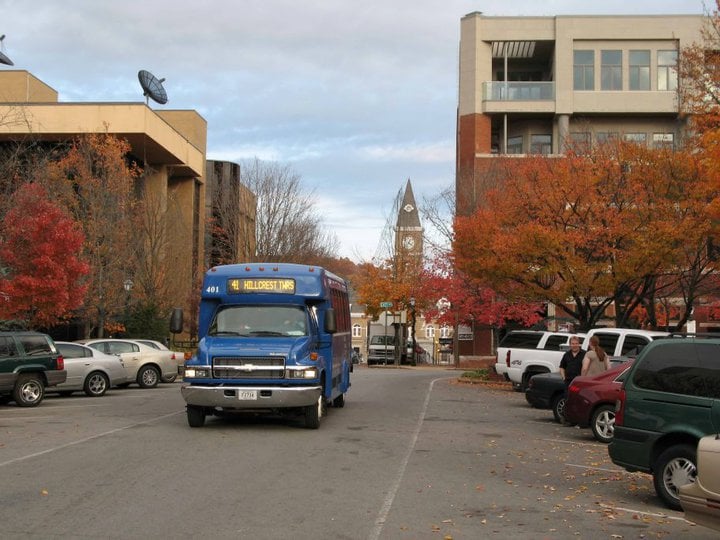
An Ozark Regional Transit bus on the Fayetteville square
Courtesy
The League of Women Voters of Washington County will host a forum on the future of public transit in Northwest Arkansas Thursday at Fayetteville Public Library.
The forum will feature four panelists; Mayor Lioneld Jordan, Fayetteville Development Services Director Jeremy Pate, Ozark Regional Transit board member Jerre Van Hoose, and NWACC student and transit user Christian Cortez.
The discussion will be centered on the recently passed half-cent sales tax, and ways to utilize an estimated $80 million in turnback funds that will be made available to Northwest Arkansas cities and counties for transportation projects. The panel will also discuss ways to encourage leaders to make pubic transit a priority, and citizens to walk, bike, or utilize public transit in their daily lives.
The forum will take place from 6-7:30 p.m. on Thursday, March 14 in the Walker Community Room inside the Fayetteville Public Library.



Enclosed bus stops, similar to the one stationed near the public library with well illustrated maps and schedules on said enclosed stops. Use the sidings of both the enclosed bus stops as well as the buses themselves for large ad space creating revenue. The buses themselves containing mobile, wi-fi hot spots.
I am sorry that I can’t attend this session. I work with international students at UA and it’s the #1 complaint about our city. I’d LOVE to take public transit to work if I could. Kick back and read a book instead of navigating N. College 8am traffic? Sign me up!
Who is going to pay for it?
As stated in the article, there is a recently passed half-cent sales tax with an estimated $80 million in turnback funds.
Not to mention, as I stated, if the siding of both enclosed bus stops and the buses themselves were leased as appealing advertising space, this would create more revenue.
Transit riders should also expect to pay a fare.
Well, I know Ozark Regional Transit does have riders pay a fare. I can see Razorback Transit continuing to be free for University of Arkansas students who present a student I.D. when boarding, after all they are already paying tuition. It should be a service of the university to add convenience for students. But, there should be a small fare for anyone else using their service.
That being said, if a fare is added as part of the standard procedure, there should be some incentive added for using public transportation as opposed to their own vehicle. It should no longer be viewed as something that people are “forced” to use if their car is broken down. More smoothly running buses, more comfortable seating, more services such as wi-fi provided on the bus, stops within a closer distance to one another. The fare should in reality be a convenience fee, not simply an act of taking money from those who are already forced to use the services.
Although Fayetteville and Northwest Arkansas as a whole isn’t on the same scale, we should be looking towards pioneers of the public transit system for influence. For example, Bogotá has their TransMilenio system employees “feeder buses”, smaller buses that travel through the more residential, slower speed areas, making more stops along the way. These smaller buses then feed into the larger bus stops that only travel along major highways, thus being able to continue along their path at a higher rate of speed without having to worry about traveling through slower speed areas and shortening the length of the route.
We may not be able to ‘borrow’ everything from these transit systems located in major metropolitan areas, but we should at least look at them for influence. How they create revenue from their systems, while providing convenience for users and incentive to convert to means of public transportation.
What’s the best transit system on Earth for a community of 75-125K?
Although they are both quite a bit larger than Fayetteville and even have metropolitan areas larger than or equal to Northwest Arkansas, I believe that two areas to look towards for inspiration are New Haven, CT and Grand Rapids, MI.
Both cities are no where near the size of say Portland, OR or San Francisco, CA and yet have made huge leaps in their public transportation systems.